

Losing a pet is losing family, and most people freeze up when it’s time to say something about it. You don’t want to sound like a form letter, but you also don’t want to overthink a text message that just needs to say I’m here.
This roundup gives you pet sympathy messages for every situation a coworker’s cat, a best friend’s dog, a child’s first pet, a long, slow illness, or a sudden accident plus real guidance on picking the right one and using it well. You’ll find over 120 messages sorted by tone and occasion, short enough to text and warm enough to write in a card.
Direct answer: A good pet sympathy message names the pet if you know it, acknowledges the loss as real grief (not “just an animal”), and offers presence over advice something like, “I’m so sorry about [pet’s name]. They were lucky to have you, and I’m here for whatever you need.” Keep it short, sincere, and free of clichés like “everything happens for a reason.”
Quick Answer:
- What to say: Acknowledge the pet by name, validate the grief, offer specific support — not generic “let me know if you need anything.”
- What to avoid: Minimizing phrases (“it was just a dog”), rushing them to get a new pet, or comparing it to a different kind of loss.
- Best format: A text for immediate comfort, a card for something they can reread later, a quote when words feel hard to find on your own.
- This list covers: short texts, comforting words for loss of pet, dog and cat-specific quotes, sympathy messages for sudden or expected loss, and religious/spiritual options.
- How many: 120+ original lines, grouped so you can scan straight to the tone you need.
Why Pet Sympathy Messages Matter More Than People Think
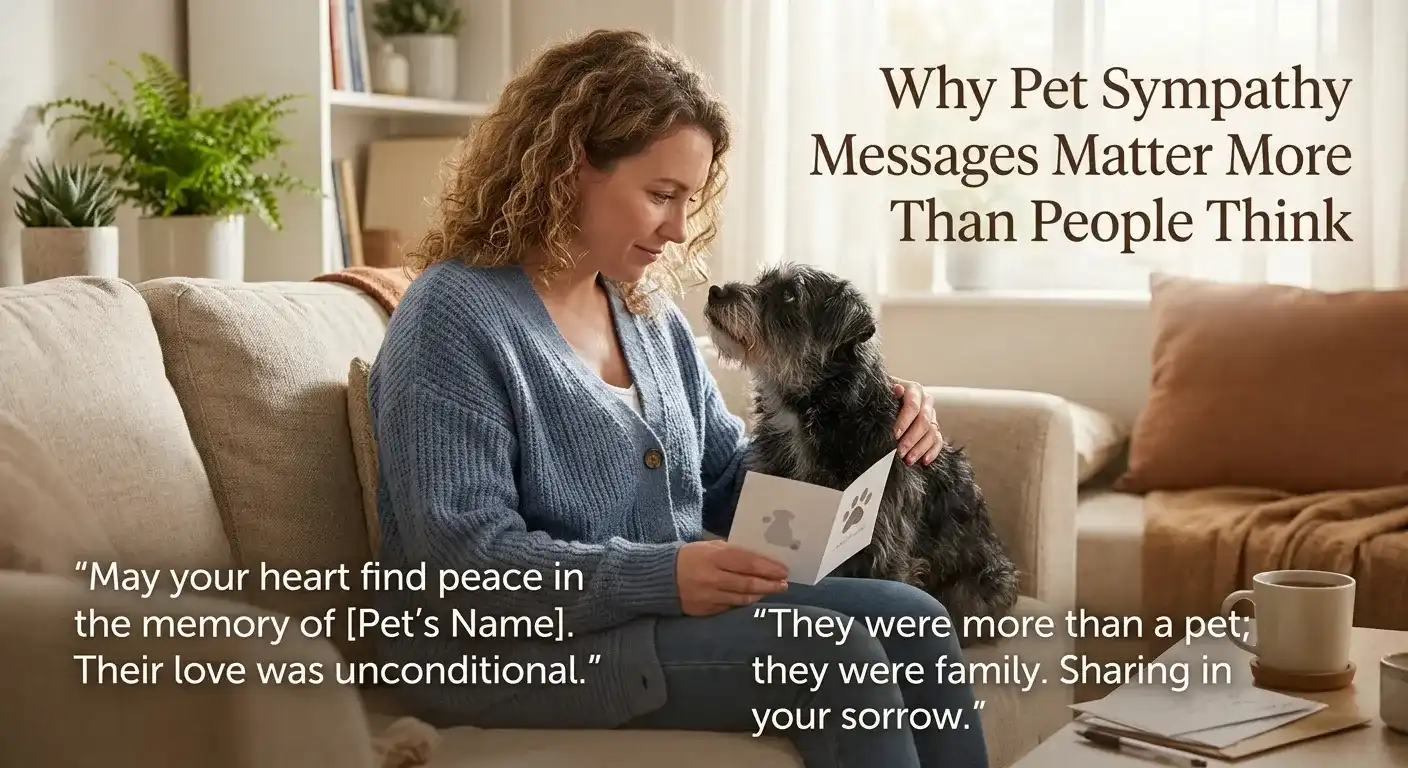
Pet grief is often dismissed by people who haven’t lived it, which is exactly why a sympathy message for a pet loss carries so much weight. Research on human-animal bonds consistently shows that grief over a companion animal can mirror the intensity of losing a close relative it’s not a smaller loss, just a less publicly recognized one.
When you send condolences, you’re doing more than filling a silence. You’re telling someone their pain is legitimate. A message that gets this right tends to be simple: it names the animal, it doesn’t try to fix anything, and it leaves the door open for more conversation later.
Short Message for Loss of Pet (When You Just Need a Few Words)
Sometimes the kindest thing is brief. These work as texts, DMs, or the inside line of a card when you don’t want to overwrite the moment.
- “So sorry about [pet’s name]. Sending you love today.”
- “I heard about [pet’s name]. My heart hurts for you.”
- “There’s no right thing to say, so I’ll just say I’m thinking of you.”
- “[Pet’s name] was so loved. That doesn’t go away.”
- “I’m here whenever you want to talk — or not talk.”
- “Thinking of you and that sweet face today.”
- “No pet like [pet’s name]. I’m so sorry.”
- “Sending you comfort and quiet today.”
- “You gave [pet’s name] the best life. I’m so sorry it’s over.”
- “This one hits hard. I’m here.”
A short message for loss of pet works best paired with an offer, even a small one — “thinking of you” plus “let’s grab coffee this week” lands more than either alone.
Comforting Words for Loss of Pet (Longer, Written Messages)

These suit a card, an email, or a longer text when you have more space to say what you mean.
- “I know [pet’s name] wasn’t just a pet — they were part of your everyday life, your routine, your comfort. That kind of absence is real grief, and I’m so sorry you’re feeling it.”
- “Grief for an animal doesn’t get smaller just because they were small. [Pet’s name] mattered, and so does what you’re going through right now.”
- “You gave [pet’s name] a life full of love, and they gave that right back to you every single day. I’m holding space for you as you grieve them.”
- “It’s okay to fall apart over this. [Pet’s name] was family, and losing family hurts no matter how many legs they had.”
- “I remember how [pet’s name] used to [specific memory] — that’s the kind of joy they brought, and I know how much you’ll miss it.”
- “There’s a particular kind of quiet that comes after losing a pet. I hope you have people around you to fill some of it.”
- “Take all the time you need to grieve [pet’s name]. There’s no schedule for this kind of love.”
- “The bond you had with [pet’s name] doesn’t end because they’re gone. It just changes shape.”
Dog Death Quotes & Loss of a Dog Quotes

Dogs tend to earn their own category of grief the walks, the door greetings, the specific weight of them leaning against your leg. These lines lean into that dog-specific bond.
- “A dog doesn’t just share your home. They share your whole day, every day and that’s what makes the silence after so loud.”
- “The best conversations I ever had were the ones where [pet’s name] just listened. I’m sorry that’s gone.”
- “Dogs love without conditions and without pause. Losing that kind of love leaves a mark that doesn’t fade quickly.”
- “[Pet’s name] taught you what loyalty actually looks like. Carry that forward, even now.”
- “The house feels different without the sound of paws on the floor. I’m thinking of you in that new quiet.”
- “A good dog rearranges your whole life around them, so it makes sense their absence rearranges it too.”
- “You were their whole world, and they were a huge part of yours. I’m so sorry.”
- “Some dogs are just once-in-a-lifetime. It sounds like [pet’s name] was one of those.”
Why this category matters: dog grief often comes with very specific triggers an empty leash hook, a food bowl still in the kitchen so messages that acknowledge the daily routine tend to land more personally than generic sympathy lines.
Pet Loss Quotes for Cats and Other Companions

Cat people and small-pet owners often get overlooked in sympathy card aisles. These are built specifically for that gap.
- “[Pet’s name] had a whole personality, and you knew every inch of it. That kind of familiarity is hard to lose.”
- “Cats choose who they trust, and [pet’s name] chose you. That says everything.”
- “The quiet companionship you had with [pet’s name] was its own kind of love language. I’m sorry it’s gone.”
- “Small animal, huge presence. I know how much space [pet’s name] took up in your life.”
- “Whether it was fur, feathers, or scales, the love was real — and so is this loss.”
- “[Pet’s name] had a way of making a room feel like home. I’m sorry that’s missing now.”
Sympathy Messages for Sudden or Unexpected Pet Loss
Sudden loss — an accident, an undiagnosed illness, a pet who was “fine yesterday” — carries its own kind of shock. These messages account for that.
- “No warning, no chance to prepare — that makes this so much harder. I’m so sorry.”
- “Sudden loss steals the goodbye. I wish you’d had more time, and I’m here for whatever comes next.”
- “There’s nothing that could have made this easier to hear. I’m just so sorry.”
- “You didn’t get the long goodbye, but you gave [pet’s name] a full, loved life. That still counts for everything.”
- “Shock and grief together are exhausting. Be gentle with yourself today.”
Sympathy Messages After a Long Illness or Difficult Decision
When a pet has been sick for a while, or when euthanasia was involved, the grief often comes tangled with guilt. These lines are written to soften that specific weight.
- “You made the hardest, most loving choice a pet owner can make. That was an act of love, not a failure.”
- “Ending suffering out of love is still love. Please don’t carry guilt for giving [pet’s name] peace.”
- “You cared for [pet’s name] through the hardest part. That kind of devotion doesn’t go unnoticed.”
- “The decision you made was the last gift you gave them. I hope you can find some peace in that, eventually.”
- “You showed up for [pet’s name] every single day of their illness. That’s everything a pet could ask for.”
How to Write a Condolence Message for Pet Loss (Step-by-Step)

If none of the lines above feel quite right, here’s how to write your own condolence message for a pet loss in under two minutes.
Step 1 — Open with the pet’s name, if you know it. “So sorry about Max” reads far warmer than “so sorry for your loss.”
Step 2 — Validate, don’t minimize. Skip “at least” and “it was probably for the best.” Stick to acknowledging the loss is real.
Step 3 — Add one specific detail, if you have one. A shared memory, a personality quirk, anything that shows the pet was known and not just a category.
Step 4 — Offer presence, not a project. “I’m here” beats “let me know if you need anything,” because it doesn’t put the work of asking back on them.
Step 5 — Keep it shorter than you think it needs to be. A sincere two sentences will always outperform a rehearsed paragraph.
My Condolences vs. Sympathy Message What’s the Difference for Pet Loss?
“My condolences” tends to read as slightly formal better suited to a coworker, a boss, or someone you don’t know well. A sympathy message has more room for warmth and personal detail, which usually fits a close friend or family member better.
For pet loss specifically, most people lean toward the warmer, less formal option, since the relationship with the pet and often with the grieving person tends to be intimate rather than professional.
How to Use These Pet Sympathy Messages
Picking the right line depends less on finding the “perfect” wording and more on matching the message to the moment and the relationship.
- Texting a close friend? Go short and personal pull from the short message section and add their pet’s name.
- Writing inside a card? Use one of the longer, comforting-words lines, and consider adding a quote underneath for extra weight.
- Don’t know the person well? Lean toward “my condolences” phrasing and keep it brief and respectful rather than overly familiar.
- Sending flowers or a gift? Pair a short line with the gift tag rather than a long paragraph the gesture already says a lot.
- Not sure if they want to talk about it yet? Choose a message that offers presence without asking questions, so they can respond whenever they’re ready.
A message that’s slightly too short rarely causes harm. A message that overexplains, offers unsolicited advice, or tries too hard to relate (“this reminds me of when I lost my hamster”) tends to land worse, even with good intentions.
Frequently Asked Questions
What is a good short message for loss of a pet?
A good short message names the pet if you can, keeps it to one or two sentences, and avoids clichés something like, “So sorry about Bella. Sending you love today” covers it well.
What should you never say to someone who lost a pet?
Avoid “it was just a pet,” suggestions to get a new one right away, and comparisons to unrelated losses. These minimize grief that’s already often dismissed by others.
Is it okay to send a pet sympathy message by text instead of a card?
Yes — a text is completely appropriate for immediate comfort, especially with close friends. A card is a nice follow-up if you want to give them something to keep.
What’s a comforting pet loss quote that isn’t overused?
Look for quotes that speak to the specific bond rather than generic sentiment lines about loyalty, routine, and daily companionship tend to feel more personal than broad “rainbow bridge” phrasing.
How soon should you send a condolence message after a pet dies?
As soon as you hear, even if it’s brief. A quick “thinking of you” the same day matters more than a longer message sent a week later.
Can these pet sympathy messages be used for any type of pet?
Yes — most of these are written to work for dogs, cats, or any companion animal by simply swapping in the pet’s name and adjusting a detail or two.
A Final Word
There’s no message that erases what someone’s feeling after losing a pet, and that’s not really the goal. The goal is to make sure they know they’re not grieving alone.
Pick whichever line above feels closest to how you’d actually talk to this person, add their pet’s name, and send it that’s already more than a lot of people manage to do.
If you’re looking for more ways to put comfort into words, browse our other condolence and comforting-words collections for loss messages that fit beyond pets too.

Hi, I’m Sophie Harrison — an SEO content writer with 4 years of experience. I currently write for blessingmeans.com, where I create content that’s both search-friendly and genuinely engaging for readers.
